EMG sensing
Surface muscle activity and changes in tension.

MACLEE R&D / NEUROWEAVE
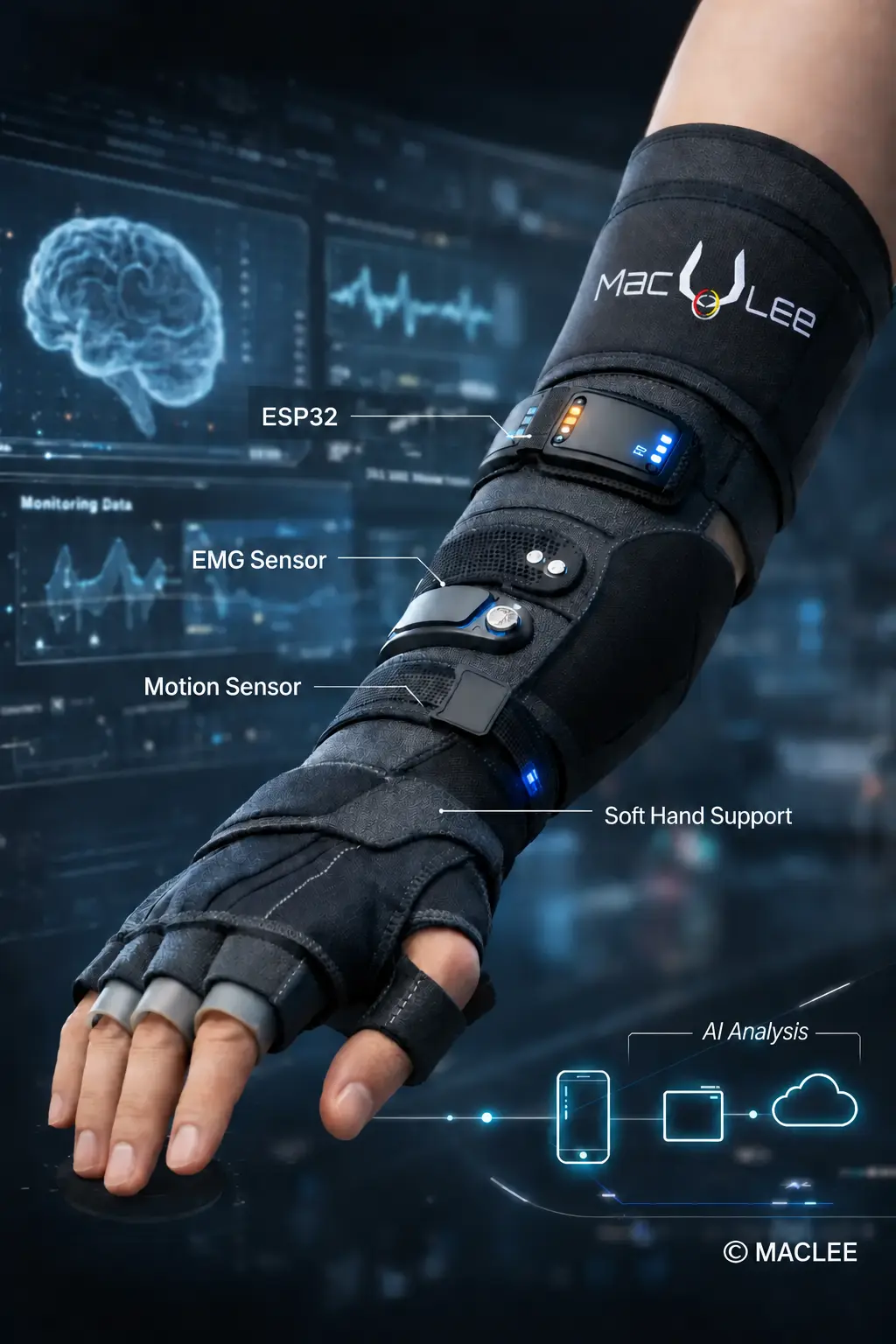
For people who cannot reliably express pain, discomfort or stress, caregivers often depend on experience and interpretation. MacLee initiated NeuroWeave to investigate whether non-invasive technology can add a more consistent layer of information.
The aim is not to replace human care or medical judgement. It is to explore whether changes in muscle activity, movement and posture can be recorded over time and compared with a person's own baseline.
That distinction matters. NeuroWeave begins with observation, personal patterns and responsible research—not universal conclusions.
The research architecture combines proven sensing components with a modular wearable and a software layer designed by MacLee.
Surface muscle activity and changes in tension.
Movement, orientation and posture through inertial sensing.
An ESP32-based module for local acquisition and secure transfer.
Personal baselines, timelines and exploratory AI-assisted analysis.
3D printing allows MacLee to test fit, comfort, sensor positioning and protective enclosures without waiting for industrial tooling. The first prototype will combine printed mechanical parts with established EMG and motion-sensor modules.
Research question, system architecture, signal sources and responsible product positioning defined by MacLee.
Build the modular wearable, integrate EMG and motion sensing, and develop the first data interface.
Evaluate comfort, repeatability, motion artefacts, battery behaviour and data quality in controlled tests.
Prepare structured evaluation with suitable technical, care and academic partners.
MacLee welcomes conversations with sensor specialists, wearable engineers, researchers, rehabilitation professionals and care organisations interested in responsible prototype development.
Discuss a partnership